Field of Science

Showing posts with label Chemistry. Show all posts

The magical role of the doormen


Half of all pharmaceuticals work because of a family of proteins that sit on the boundary of cells in the human body. This year’s Nobel prize in chemistry was awarded to Robert Lefkowitz and Brian Kobilka for their work on a family proteins called G protein-coupled receptors (GPCRs). Nearly every function of the human body from smell and sight to heart rate modification is dependent on GPCRs. Dr Lefkowitz and Dr Kobilka have helped us understand their chemical structure and mode of action to help create better means of manipulating them to our advantage.  

Robert Lefkowitz
Credit: Wikipedia
Embedded in the fatty membranes of cells, GPCRs act as doormen to a mansion. They detect chemical signals that reach the cell and convey messages through creation of G proteins inside the cell. These G proteins that take on the role of maid servants then act on the message by activating the necessary response.

But this was not known until the 1960s. All that was known then was that hormones communicated with cells in someway but no one knew how. Dr Lefkowitz started probing these hormones by attaching radioactive isotope Iodine on to them. This revealed that the cell membrane had special proteins that acted as telegraph operators relaying information from one side to the other. He was able to identify one class of these proteins called beta-2 adrenergic receptors. These are interesting because they are now implicated in responding to the neurotransmitter adrenaline known to control the fight-or-flight response.

In 1984 when Dr Kobilka arrived in Dr Lefkowitz’s lab, the lab was working on duplicating the gene sequence that made beta-2 adernergic receptors. If they could, then it would enable them to know more about the role of these proteins and how they work. When they eventually managed to do it, after a lot of failed attempts, they realised that this protein was very similar to rhodopsin, a protein that sits in the retina and is responsible our perception of light. Rhodopsin was known to activate G-proteins in the cell and that is it was thought that these could be a class of proteins, now known as GPCRs.

We now know that human body has about 800 GPCRs splayed across different cells performing some of the most critical functions. About half of these are predicted to be pharmaceutically useful, but less than 10% of that have drugs targeting them today. A major hurdle in creating pharmaceuticals for them is because little is known about the chemical structure of these proteins.

Brian Kobilka
Credit: Stanford
A way to shine light on the chemical nature of proteins is by using X-ray crystallography. To do that though, a protein first needs to be crystallised (lots of molecules arranged in a regular fashion in a tiny space). Proteins, in general, and GPCRs, particularly, are notoriously difficult at doing that. Of the 63 million proteins registered in the database of the Chemical Abstracts Service, only 600 have comprehensive structural data available for them. But in 2007 after decades of work Dr Kobilka managed to tame the beta-2 adrenergic receptors and published its structure in Nature.

The pharmaceutical industry has only started scratching the surface when it comes to designing drugs that affect GPCRs. And that has been the result of many decades of efforts by structural biologists and medicinal chemists in academia and industry. The work of Dr Lefkowitz and Dr Kobilka has opened the possibility of better understanding what one scientist calls cell biology—an alien world that has the most profound impact on humanity.

Main references:
  1. Rasmussen et al, Nature, 2007
  2. Buchen, Nature, 2011
  3. Sansom, Chemistry World, 2010

A more powerful but less sensitive explosive


Pharmaceutical companies exploit a process called co-crystallisation to optimise the physical properties of drugs. Now scientists developing new explosives have done the same. As I report in The Economist, researchers from the University of Michigan have developed a method to lower the sensitivity of an explosive without losing its explosive power. 

Explosive power depends on two factors: detonation velocity (the speed at which the shock wave travels on explosion) and oxygen value (number of oxygen atoms per carbon atom). The higher the detonation velocity the more destruction it will cause. Oxygen value matters because when the explosion occurs carbon atoms within the explosive would like to react with oxygen atoms to form carbon dioxide. But because there is little time for carbon atoms to find oxygen from the air. Instead it has to rely on oxygen atoms within the explosive. Thus the closer the number of oxygen atoms per carbon atom is to two, the better the explosive.

One such explosive that has a higher detonation velocity and a better oxygen value than any of the commonly used explosives is CL-20. But it suffers from low sensitivity, which means that it will explode very easily if dropped or rubbed. This has meant that despite its early development it has mainly remained on the army barracks shelves.

Not anymore. Adam Matzger and colleagues have now made a hybrid explosive that has the same explosive power of CL-20 with reduced sensitivity. Find out how they made it here.

List of main references:
  1. Matzger et al, Crystal Growth & Design, 2012
  2. Matzger et al, Angew Chem Int Ed, 2009
Free image from here.

When waiting is not an option

I have an article published in The Economist's Babbage blog about how some patients with a terminal diseases are second-guessing pharmaceutical companies and medicating themselves. Here's the blurb:
It takes eight years on average for a drug to receive approval from America’s Food and Drug Administration (FDA) after clinical trials have been successfully completed. Some patients of amyotrophic lateral sclerosis (ALS), with a life expectancy of two to five years after diagnosis, do not want to wait that long. Since September 2011 some of those diagnosed with the fatal disease have taken to injecting themselves with a substance whose chemical identity they deduced from published literature, and which they claim is currently being clinically tested.... read more.
Here is a set of main references:
  1. Neuraltus Pharmaceuticals press release
  2. James Heywood et al. Nature Biotechnology, 2011
  3. Eric Valor's conjecture
  4. ALS Study Shows Social Media's Value as Research Tool - The Wall Street Journal
  5. Frustrated ALS Patients Concoct Their Own DrugThe Wall Street Journal
  6. PatientsLikeMe - Lithium and ALS, sodium chlorite, NP001
  7. ALS Chlorite

How does epigenetics shape life?


Identical twins, despite being biologically identical at birth, grow up to become unique individuals. Sure they may have a lot more things in common than two randomly picked individuals, yet there are many characteristics which belong only to one or the other. If the twins have the exact same DNA, then what is that makes them different?


The common answer to this question is it’s the environment that they live in which shapes them differently. Researchers have found that such environmental factors cause chemical modifications to the genome without affecting the nucleotide sequence, leading to the unique characteristics that we observe. This field of research is called epigenetics, and beyond the DNA, it’s what shapes our lives.

Rat mothers nurture their pups by licking and grooming. Researchers in Canada studying epigenetic changes found that rats whose mothers licked them more than normal expressed hundreds of genes differently from those who were licked less than normal. These differences were consistent and predictable, and led to a number of behavioural changes among the rats, including one where highly licked rats’ response to stress was a lot better than the less‐licked rats’.

Epigenetic changes don’t just occur through environmental factors but are also a different form of inheritance, one that doesn’t have to suffer from the randomness of natural selection. The licking of the rat encodes specific information onto her pup’s DNA without modifying to the sequence of base pairs. Mom’s behaviour programs the pup’s DNA in a way that will make it more likely to succeed. Such information is stored in the DNA in many ways, one of which is through DNA methylation. Through this process methyl groups are attached on to the DNA, and their attachment at specific positions leads to genes being turned on or off. This makes epigenetic changes reversible. For example, you can take a low‐nutured rat, inject its brain with a drug that removes methyl groups, and make it act like a high‐nurtured rat.

DNA methylation also plays a key role in cell division and cancer cells are known to divide faster than normal cells. Researchers in the US have developed drugs to interfere with DNA methylation as a treatment for cancer. They use molecules that mimic cytosine, one of the four bases of DNA. In cell replication, the fake cytosine swaps places with real cytosine in the growing stand of DNA, which then in turn traps DNA methyltransferase. When used in low enough doses, the drug allows the formation of the cell but with less methylated DNA. These drugs are currently being used to treat myelodysplastic syndrome, a prelukemia condition.

As Brona McVittie says, like the conductor of an orchestra controls the performance of musicians, epigenetic factors govern how the cell plays the notes in DNA. A better understanding of these factors has  he potential of revolutionising evolutionary and developmental biology, thus affecting practices from medicine to agriculture.

Further reading:

  1. Learn Genetics, The University of Utah
  2. Introduction to epigenetics from Science magazine
  3. More ways to fight cancer through epigenetics, The Economist
Image credit: SciShark

Macromolecules from miniature templates

From my article in Chemistry World:

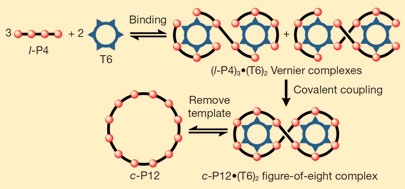
UK researchers have designed a new highly effective method to construct large molecules of a defined size using simple templates.Recent approaches to the construction of nanomaterials have made use of advanced methods such as living polymerisation and self-assembly, but these techniques often produce a mixture of products. Taking inspiration from nature, which uses sophisticated templates such as the ribosome to make precise complex molecules, Harry Anderson's group at the University of Oxford has developed a new strategy to synthesise macromolecules with precise lengths using basic templates...read more.

Using fruit flies' sweet tooth

From my article in Chemistry World:

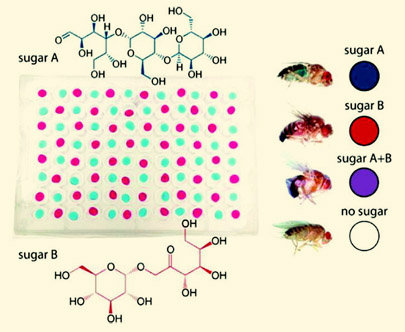
Australian researchers have used fruit flies' sweet tooth to help in attempts to develop new sugar alternatives.The Drosophila melanogaster species of fruit fly has marked similarity to humans in its choice of sweeteners, a fact exploited by a team led by Anne Rae at the Commonwealth Scientific and Industrial Research Organisation in Queensland to aid the search for new sweeteners as demand for healthier sugar alternatives grows...read more.

The Treasures of Urine

Michelle Clement's post on What can urine tell us? has arrived at an opportune time. I am reading John Emsley's The Shocking History of Phosphorus and much of the first chapter is about the discovery of phosphorus from urine.

Alchemists of the day were desperately and highly secretively searching for the philosopher's stone. Henning Brandt, the discoverer of phosphorus, thought because urine is golden there must be something in it which make is to golden. Possibly gold?

In his attempts to isolate gold out of urine, Brandt evaporate urine to a paste and heated the residues hard to find shining vapours rising from it. When condensed he found that the shining liquid burst into flames if brought in contact with air. So he started collecting the vapours under water instead. The waxy, white solid that formed at the bottom was phosphorus.

So why phosphorus from urine? We tend to eat a lot more phosphorus than is needed by our body. So most of it is excreted.
A typical sample of urine from an adult male contains (per litre) - 52 g creatine, 21 g urea, 6.5 g chloride, 4 g sodium, 2.2 g potassium, 2.3 g amino acids, 1.4 g phosphorus, 0.7 g ammonia and  0.3 g magnesium.
Although Brandt had discovered this light-giving element in 1669, he did not divulge the method of obtaining phosphorus until 1678, by which Johann Kunckel, professor at the University of Wittenberg, had succeeded to isolate phosphorus and was touring the  European royal courts showing off the element and claiming to be its discoverer.

For many years it was thought that Kunckel discovered phosphorus, until papers from Leibniz (yes, the same calculus guy!) revealed that he had conversed with Brandt's wife about the discovery of phosphorus and which finally gave credit to the its true discoverer.

It seems that for at least a hundred after its discovery, urine remained the only source to obtain elemental phosphorus. Even today 3 million tonnes (worth ~$1 billion) of phosphorus is obtained from human excreta. Such are the treasures of urine.

Healing Polymers by Light


Polymers that can be healed could extend the lifetime of materials in so many applications. Chemists from the US and Switzerland have for the first time developed polymers that can be healed by exposure to ultraviolet light alone.
In the recent years, many strategies have been developed for healing polymers. In many cases, they are healed by heating to the glass transition temperature which transforms the polymer from its hard state into a molten state enabling the polymer chains to reform. Unfortunately, this technique is slow and difficult to use in practice. To overcome the problem, a method was needed to manipulate polymeric structure at the molecular level.
Burnworth et al. used supramolecular polymers which are lower molecular mass polymer units held together in long chains by metal-ligand bonds. These non-covalent bonds are weaker than the bonds that hold hydrogen and oxygen atoms in a water molecule but strong enough to enable the new material to possess polymer-like properties.
Healed by UV light
Metal atoms have special affinity to electron rich ligands. This allows metal atoms to form metal-ligand bonds in a polymer with ligand groups present in it its structure.
More importantly, working with these metal-ligand bonds has enabled the researchers to manipulate the bonds at the molecular level with light energy. A polymer sheet deliberately cut to 50% of the film thickness was exposed to UV light in the range of 330 – 390 nm. It was observed (as seen in the picture) that the polymer ‘healed’ by filling up the cut that was made earlier.
Metal-ligand bonds of the kind present in this polymer allow for the conversion of light energy into heat. In this case, the light energy causes the surface of the polymer to rapidly heat up to 220 °C in a very short time. The healing occurs in this state when polymer is allowed to flow and re-arrange. The advantage of using light energy lies in its specificity. Unlike heat energy, it is possible to direct light energy to precisely those areas which require repair.
Also because different metal-ligand complexes absorb light at different wavelengths it should be possible to tune the wavelength of light needed for healing. Thus, one can imagine that it may be possible to heal a broken mobile phone case just by keeping it in sunlight.
Reference: Mark Burnworth et al., Nature, 472, 334.

Porous silica makes funky coloured films and could lead to warmer windows

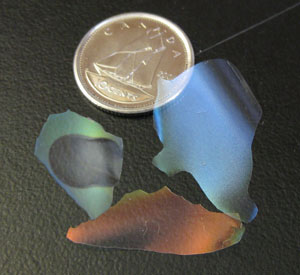
Using nanocrystalline cellulose (NCC) from wood pulp, Canadian researchers have for the first time prepared mesoporous chiral nematic structured silica materials that may have potential as tuneable reflective filters in smart windows, chiral catalysts in synthesis and even as optical sensing devices.. read more.

Chemistry that can change the world – II

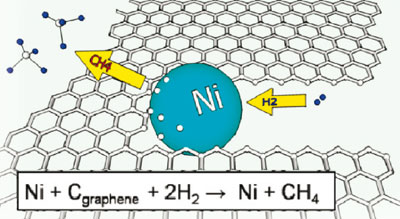
Ni nanoparticles absorb carbon from graphene edges
which then reacts with H2 to create methane
New Scientist has published the second half of it’s 50 ideas to change science forever list, and it’s no surprise chemistry featured heavily again. So see the rest for yourself... read more.

How 'green' is your detergent?

Fragranced household products, even those labelled as 'green', can emit large numbers of hazardous chemicals that aren't listed on their labels, US researchers have confirmed. The research raises questions about the risks associated with these products and regulating the claims on their labels.

A team led by Anne Steinemann at the University of Washington in Seattle, US, used gas chromatography to analyse the volatile organic compounds (VOCs) released from 25 of the top-selling US products such as detergents, hand sanitisers and air fresheners, and found that they emit many hazardous compounds... read more.

Mining soil DNA for molecular decorators

Enzymes (rings) found in eDNA libraries can modify glycopeptides cores (top) in new ways
US Researchers have harnessed enzymes hidden in the genomes of soil bacteria to modify a natural antibiotic molecule in ways that would be difficult or impossible by traditional synthesis. The technique could be applicable to other families of molecules, providing easy access to a huge variety of complex molecules... read more.
ResearchBlogging.org
Banik, J., Craig, J., Calle, P., & Brady, S. (2010). Tailoring Enzyme-Rich Environmental DNA Clones: A Source of Enzymes for Generating Libraries of Unnatural Natural Products Journal of the American Chemical Society DOI: 10.1021/ja105825a

Chemistry that can change the world

After the Economist questioned the value of chemistry last week, today I read with keen interest seeking chemistry in the special article in New Scientist titled ‘50 ideas to change science forever’. Although they have only released 25 ideas in the current issue, I could find at least 10 ideas which were either all chemistry or had a heavy connection to chemistry.


Here's my list....read more.

How did our nitrogen cycle evolve?

In trying to feed our growing population, we now add twice as much nitrogen to the soil (after chemically ‘fixing’ it to make fertilisers) as microbes fix from the atmosphere. Human activity has skewed the balance in the earth’s nitrogen cycle. But how did the modern nitrogen cycle evolve? A recent review published in Science tries to answer that question and make suggestions about the future. ...read more.

ResearchBlogging.org

Canfield, D., Glazer, A., & Falkowski, P. (2010). The Evolution and Future of Earth's Nitrogen Cycle Science, 330 (6001), 192-196 DOI: 10.1126/science.1186120

Have we solved all the questions in chemistry?


If the polymath Charles Babbage was alive, I don’t think he would have said this: ‘With completion of the periodic table, though, and with modern understanding of chemical bonds as quantum phenomena caused by the pairing of electrons of opposite spins, chemistry as an intellectual discipline looks, to the outsider at least, to have been largely solved.’ But the Babbage from the Economist certainly seems to think so.
Err…I beg to differ and so will the millions of chemist who do research...read more.

Synthesis of Hygromycin A

Retrosynthetic analysis of Hygromycin by Donohoe et. al.
Shown to be a broad-spectrum antibiotic which also exhibits immunosuppressant activity, Hygromycin A has an intriguing structure and yet has only been synthesised once before (Ogawa et. al. 24 linear steps and 1% yield). Donohoe's retroysynthesis aims at addressing two key issues in the the sugar moiety: epimerisation at C4 and glycosylation of Î²-anomer. The route also aims at making use of the group's methodology, the tethered aminohydroxylation (TA) reaction in synthesising the inositol portion.

The TA-reaction at work
The sugar is synthesised by standard reactions but with triisopropyl protected alcohols at C2 and C3, the aim of which is to force the Î²-anomeric configuration and to protect the epimerisation of C4 by hindering the vulnerable proton. A strategy that eventually paid off. The sugar was then attached to B by a selective mitsonobu reaction  (slow addition of DIAD, tiphenyphosphine, toluene at 60 deg C) which on optimisation gave 9:1 ratio for the Î²-anomer with excellent yield.

The inositol portion was synthesised using the key TA step which had an superb yield of 74% on using (only) 1 mol% catalyst loading, giving the desired diastereomer exclusively. This step has been improved upon the previously reported result (61% yield at 4 mol% catalyst loading). The attacment of the inositol portion to the B+C part was achieved using standard coupling reagents and on deprotection yielded Hygromycin A in 17 linear steps and 10% overall yield a great improvement over the previous synthesis.

ResearchBlogging.org
Donohoe, T., Flores, A., Bataille, C., & Churruca, F. (2009). Synthesis of (−)-Hygromycin A: Application of Mitsunobu Glycosylation and Tethered Aminohydroxylation Angewandte Chemie International Edition, 48 (35), 6507-6510 DOI: 10.1002/anie.200902840


We the Molecular Architects

No, I am not talking about Eric Drexler's molecular nanotechnology which is still many many years away, if at all possible. Right now without a second thought I would call organic chemists Molecular Architects, especially the ones who work in the field of Natural Product Synthesis. It is that branch of chemistry that deals with the art and science of constructing complex naturally occurring molecules in the laboratory starting with easily available raw material.

The field has been recognised with many Nobel Prizes in Chemistry:
E. Fischer in 1902, H. Fischer in 1930, R. Robinson in 1947, R. B. Woodward in 1965, E. J. Corey in 1990.
Their contributions are only the few spikes in this field where every molecule synthesised has the potential of making a significant contribution. Every synthesis is a brick (or as Lehn calls it a stone)  in this construction of this structure called science, irrespective of it's position in the structure. It helps push the frontiers of the already existing synthetic methods and often leads to new methods helping to build a great library of chemical literature.
I am hoping to write a series of posts on the publications that interest me and I will keep updating this post with the posts in this category.

  1. Synthesis of Cylindricines
  2. Synthesis of Hygromycin A

Synthesis of Cylindricines

The family of tricylic compounds despite being known to possess no significant biological activity have been a target of many previous syntheses because of it's challenging structure. The paper in discussion today is the synthesis of Cylindricine C synthesised in the Chemistry Research Laboratory at Oxford University which elaborates the use of the recently published methodology by the Donohoe group.

Most of the previously reported synthesis (Snider, Heathcock, Molander, Trost and Kibayashi) have relied upon the late-stage construction of the six-membered B ring but Donohoe's synthesis was planned to begin with the ring B in place. It began with the commercially available picolinic acid which was converted to the disubstituted N-protected pyridine. Then Donohoe and co-workers extended the scope of their own methodology (previously shown N-methyl and N-allyl pyrdinium salts) by showing more examples of Grignard addition to N-DMB protected pyridinium salts. 


The key intermediate was prepared in a stereo and regio-selective manner with that methodology. After the ring closure and  the subsequent nucleophilic addition of the alkyl Gringard (HexMgBr) gave the desired diastereomer as the major product (X-ray structure). Further maniuplation of the ester side-chain through a series of well-known chemistry yielded them an intermediate aldehyde which could (using Snider's method) lead to cylindricine A, thus completing a formal synthesis of it. Also the same intermediate aldehyde was then converted to give cylidricine C as well.

ResearchBlogging.org
Donohoe, T., Brian, P., Hargaden, G., & O’Riordan, T. (2010). Synthesis of cylindricine C and a formal synthesis of cylindricine A Tetrahedron, 66 (33), 6411-6420 DOI: 10.1016/j.tet.2010.05.044

The Father of Supramolecular Chemistry: Jean-Marie Lehn


The Lindau Nobel Laureates meeting has been a fantastic opportunity to mingle with brilliant minds for all over the world who work in widely different areas of science. Yet as a chemist, there were certain interactions which I enjoyed far more than others. Once such interaction was the time that I spent talking to Prof. Lehn. 

I had 15 minutes to 'interview' Jean-Marie Lehn who shared the 1987 Nobel Prize in Chemistry with Donald Cram and Charles Pederson for their development and use of molecules with structure-specific interactions of high selectivity. Prof. Lehn is more commonly known as a father of supramolecular chemistry.

In his lecture that morning, Lehn was his usual charming self when he tried to explain to the people the importance of supramolecular chemistry. "Chemistry is a bridge between Physics and Biology. It tries explain how complexity arose particulate matter", he said with conviction. He then delved into explaining self-organisation and showed the beautiful structures that he has synthesised over the years by the use of weaker non-covalent bonds.

Lehn Chemistry
Chemistry is a bridge between Physics and Biology.
My 'interview' lasted well beyond 45 minutes and became more of an informal conversation just after a few questions. It was quite unnerving spending one to one time with a Nobel laureate but Prof. Lehn's personality made me feel at ease. I started with picking up on his mention of the term 'Darwinian Evolution'.

JML: I used the term but what I meant was that Darwinan evolution is limited to the biological aspect but before that happened the molecules themselves had to evolve to enable this further (biological) evolution. My point was to explore the idea of how did atoms come to be able to self-organise.

AR: : If we look at the chemistry of life today do you think there is way of improving it? For example, Nature does photosynthesis in a beautiful manner but the conversion is less than 1%. Do you think there is a chance to improve that?

JML: Sure. Once you look at the schematic representation of the reaction, you could think of ways to improve and perhaps write books on it. But to give you a shorter answer I think there are two approaches that we can take. 

Firstly, we can look at the way of improving the key biochemical processes photosynthesis itself. A lot of energy is lost to keep the plant cool. So maybe we can think of building plants which are more resistant to heat. Genetically modified plants can be one answer and we can imagine more efficient plants, call them ‘energy plants’. And I believe, contrary to what ecologists think, they can still be beautiful plants. 

The other approach is that nature has developed in the course of evolution what we know around us but it is only one expression we know about. Can we have another expression, a better one? So we still convert solar energy into chemical energy with better yield by a completely new process. 

AR: So is it something on the line of Prof. Szostak’s research on the origin of life where he is producing these artificial nucleic bases which can polymerise to form artificial DNA without the need of DNA polymerase? 

JML: No, not really. That is the biological way of doing things and it’s one way but I am thinking of chemical catalysts than can achieve conversion of solar energy into chemical energy. We have worked on that in the late 70’s to early 80’s after the first oil crisis to find catalysts which can split water and I think significant progress has been made. But now, that research has been left aside because oil has become cheap again. 

It is simple reaction and I am convinced that we will be able to do it. Yes but it is also these very simple reactions which can be very hard to master.

AR: Just like we can at least conceptualize the combination of covalent bonds that will lead to an organic molecule through total synthesis, can we have a retrosynthetic way of achieving supramolecular targets?

JML: I think we are already doing it. We call it design. So say we want to build a cylinder. What is a cylinder, two discs held apart by something. Now, (at the molecular level) we think about what can be used to make the discs and what can be made to hold them apart. Then we synthesise them and it works. For example, Makoto Fujita in Japan, Kenneth Raymond and Fraser Stoddart in the USA are all working on similar thing.

We can achieve this by manipulating properly the non-covalent interactions that bring atoms together. I call this the algorithm because it is not just binding but binding according to certain rules. In case of metal ions it is the rules of co-ordination chemistry, rather simple but it is, for me, the algorithm of reading. Even if some people don’t like this (term) because co-ordination chemists will think that co-ordination chemistry has been around for hundred years that that is correct but the way in which metal ions bind is an algorithmic way. A tetrahedron or an octahedron, it is an algorithmic way of reading information. Hyrdogen bonds? Nature has used them since the beginning of life, Adenine & Thymine and Guanine & Cytosine hydrogen bond at 2 or 3 locations and that’s an algorithmic way of binding.

You can also build more complex structures where you can have hydrogen bonds on one face and covalent bonds on the other face. The advantage of metal ions is that from one point it arranges the atoms around it in a certain manner. If we want to achieve the same with hydrogen bonds we need multiple sites. We can do it but it’s a bit more spread out and you need more matter, so to say, to achieve the same result.

So yes, I think we have an established way of achieving our targets. Actually, here is an analogy, a retrosynthetic analysis involves choosing a target and then breaking it down to pieces and in the process of reconstructing it you have reactions. Now in supramolecular chemistry, we do the same by cutting the target into pieces and then in the process of reconstructing it we have non-covalent bonds. 
Lehn Chemistry 2
Lehn enjoying stimulating lectures
AR: Like in Physics we have the CERN where people are working plain curiosity-driven challenges. Similarly, in chemistry what kind of research do you think we should do that we can’t see any applications for but is something that needs to be done?

JML: I have an easy answer to that. It’s not the only answer but it is one answer. So once a guy called me and told me that he is writing a piece in Nature on important problems in science. So he talked to physicists and they said they are studying the rules of the universe, which is a big problem no doubt. He talked to biologists and they said they are studying the rules of life, big problem. Then he asked, so what are chemists doing? I guess what he was trying to say is that we are making new molecules, new materials which is all very good but where is the big problem. I told him that chemist are actually looking at the biggest problems. I mentioned this in my lecture today. Einstein helped us understand some rules of the universe from the theory of relativity but how did this species called Einstein evolve who can think and achieve this for us? What is the process? I have the answer, it’s self-organization. And it is simple, if I may say so. By using the bricks of the universe (atoms) which were built by the laws of the universe we now have such complex organisms.

AR: So is it the origin of life research in chemistry which you’d classify under this category?

JML: No, actually before the beginning of life. The research of looking into how did we come from particulate matter to condensed matter to organised matter and then to life. These steps, we know that they exist because we exist. We realise that we are still very far from complexity of biological systems, very far. But Rome wasn’t built in day, right?

AR: We students are fascinated by these big questions and it may be one of the reasons we chose to do science but in the daily life in the lab the problems are different. We work on one reaction for days to make it work with little progress. How do you think students can deal with such situations?

JML: I think this is a very good question. And I am bit embarrassed when I talk this way because I know we have young students working in the lab and yes we have big ideas but then they also have to clean flasks and mix compounds. So I think we have to realise that there are lot of nitty-gritty things in the lab that we have to do every day but at the same time we have to realise that we are part of a big project to understand what’s going on (in the world), why we are here and how did we come about. 

AR: What motivated you in the lab during such phases?

JML: Let’s be honest. It were small steps. Being able to make the compound that you wanted to and realising that oh yes, I got it. But all this is part of the big picture. To the young people I’d say that you must focus. Think that you are part of a big construction called science and you are not just a chemist but you are scientist. Be modest but proud. Modest because you know you will not be able to solve other problems because your life is too short. But be proud because you are contributing to it. Some people will bring a small stone to the building and some people will bring a big one but nevertheless no one can take that stone away from you. Yes, you will be happier if you bring a big stone but not everyone has the right occasion or has the right person at the right place at the right moment to be able to do that. 

AR: Today, all of scientific research in countries like USA, UK, France and more is funded by less than 1% of GDP. Why is that number so low if science makes such a big impact on the progress of the nation? What can be done to change it?

JML: We are still apes and are fighting all around the world. We are in the prisons of dogmatism, fundamentalism and religion.  Let me say that clearly. We must learn to be rational. At the end of the game, what matters the most is education. 

AR: Is it just education though?

JML: Depends on what kind of education. We have to learn to be conscious of the people around. We also want to live well. I know it’s hard. I know that sitting around in these surroundings is real nice but there are people in cities that I do not want to mention who are living in terrible conditions. We have to grasp this. Thinking that let’s do away with armed forces is idealism because even if we should, we cannot.

AR: Because if we cut down on funding the department of defence then we can use that to do science. What is science doing to improve world peace? 

JML: I think we need to be patient (about achieving world peace). The pace at which science has progressed has been too fast for human behaviour to adapt to it. As I said we are still apes. A part of our brain is still a paleo-brain and many of reactions come from our fight or flight instinct. As long as this part of the brain can take over control the rational part of the brain (we will face these problems). Some people will jump up at what I am going to say now but I think at some point of time we will have to change our brains. 

AR: So do you believe in what Martin Rees has said “To be able to overcome the big challenges of humanity we will need a more evolved human being”?

JML: Oh yes. I totally agree with him. I have spoken a lot to him. We are a result of evolution at given point in space and time, why then should we be the end of evolution? We are obviously not. We are just a point but with a fantastic advantage. Thanks to science we now have been able to (gain) better understanding of how things work. So in the future it will be possible to have possibilities to change ourselves, it will be difficult. But in the future, we will have that ability.

Our science is only 200 years old, I cannot imagine what we will be capable of in 1000 years from now. We will definitely not be the same anymore. 

AR: It is nice to hear from a Nobel laureate that he supports genetic modification and as such other transhumanistic notions. 

JML: Modifying ourselves is a natural process because we are a product of nature and what we do is a product of nature. Therefore, if one day we have three time bigger brain and two hearts instead of one (because one is not enough) then this is all part of nature. 

He then leaned back and made a comment about the weather and I took that as a clear signal of continuing the conversation.

AR: This is the fourth time that you have come to the Lindau meetings and second time since they became international. How has been your experience?

JML: You cannot compare the experience of before and after they became international, it's totally different. I've attended 2 out 3 interdisciplinary meeting and I quite enjoy them as I get to meet fellow laureates from the other fields. Listening to pioneers in other fields is quite stimulating.

Then, he asked me a few questions about my background and where I come from. When I mentioned Nashik, his eyes lit up and he said, "I know Nashik, I had recently given a public lecture in Mumbai and there was whole bus full of people who had come from Nashik to attend it."

He told me about his position on the Reliance Industries' Innovation Council which also distinguished people like Grubbs (Nobel Prize in Chemistry 2005), Whitesides, Mashelkar and Mukesh Ambani, the CEO himself."I go to Mumbai every year to give a lecture", he said. Incidentally, Mashelkar, Ambani and Manoj Modi (who Lehn praised) are all graduates from my alma-mater, the Institute of Chemical Technology in Mumbai.

AR: So do you enjoy it there?

JML: Oh yes, I quite like going to India. Whenever I have the chance, I try to combine the various invitations that I have with travelling. For instance, in 2009, we drove from Bangalore to Mumbai via Hampi and this year I had a talk in Kanpur and from there we went to Khajuraho and Orchha and to Delhi as we will flew out from there. Orchha was a very beautiful place with the temples and palaces. It was a rather small place and I like small places compared to big cities. 

AR: It’s been fantastic talking to you and I take great inspiration from your life story. From a small town in France as a son of a baker, you have gone on to achieve a lot.

Personally, I take a lot more than just this talk and the inspirational story of Prof. Lehn's life. In that short conversation I've had a sneak preview of how a chemist of his standing thinks about the various aspects of science and life. I will carry this as a strong reminder throughout my academic career.
Related Posts Plugin for WordPress, Blogger...