


 |
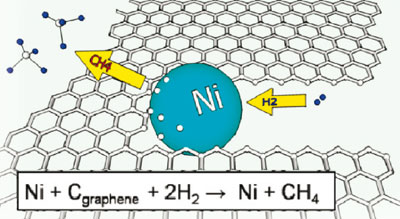
| Ni nanoparticles absorb carbon from graphene edges which then reacts with H2 to create methane |
Field of Science
-
-
Change of address1 year ago in Variety of Life
-
Change of address1 year ago in Catalogue of Organisms
-
-
Earth Day: Pogo and our responsibility1 year ago in Doc Madhattan

Chemistry that can change the world – II
How 'green' is your detergent?

A team led by Anne Steinemann at the University of Washington in Seattle, US, used gas chromatography to analyse the volatile organic compounds (VOCs) released from 25 of the top-selling US products such as detergents, hand sanitisers and air fresheners, and found that they emit many hazardous compounds... read more.
I know why the Daily Mail's news sticks in our heads
If you are a reader of newspapers in the UK and are interested in reading science news then you will also know the Daily Mail (or the Daily Hate, as some people like to call it). The reason why it is famous is not because it does really great science news, but because it does exactly the opposite. To give you a taste of what some people think of it, here is a review:

Researchers from Princeton University found that 'ideas published in hard-to-read fonts are difficult to learn but easier to remember'. Futurity reports:
PS: I am not the first person to think that they use difficult fonts, see this.
The Daily Mail is an awful, awful paper. Will happily skew the facts to make Britain out to be a country swimming with knife-wielding immigrants, benefit cheats and general disorder, turning readers into frightened reactionaries. Regularly get pulled up by media watchdogs because of journalism that is anecdotal, twisted or just plain made up. I find it dictatorial in its opinions at others, I believe there's no newspaper which has a more dangerous effect on British society.But my point is not to defame the Daily Mail, there are many who do it and it still enjoys a really large readership. I want to tell you about a piece of research that I read about which might explain why the Daily Mail's headlines (or even the content) stick in your head. The short answer is hard-to-read fonts.
Researchers from Princeton University found that 'ideas published in hard-to-read fonts are difficult to learn but easier to remember'. Futurity reports:
Apart from all the fear mongering tactics that the Daily Mail uses, these fonts might be one big reason why people tend to remember what the Mail said more that what the Times said!In the first, 28 participants between the ages of 18 and 40 were brought to a lab at Princeton and asked to learn about extraterrestrials, to limit the amount of already known information that could influence the test.The material was presented in either easy or challenging fonts. The subjects were given 90 seconds to memorize information about the aliens, distracted for 15 minutes and then tested.Those who read about the aliens in an easy-to-read font (16-point Arial pure black) answered correctly 72.8 percent of the time, compared to 86.5 percent of those who reviewed the material in hard-to-read fonts (12-point Comic Sans MS or Bondoni MT in a lighter shade).
PS: I am not the first person to think that they use difficult fonts, see this.
Subscribe to:
Posts (Atom)
