Field of Science

Using fruit flies' sweet tooth

From my article in Chemistry World:

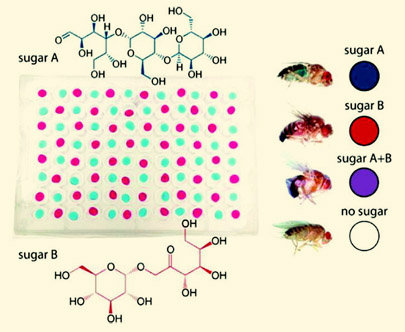
Australian researchers have used fruit flies' sweet tooth to help in attempts to develop new sugar alternatives.The Drosophila melanogaster species of fruit fly has marked similarity to humans in its choice of sweeteners, a fact exploited by a team led by Anne Rae at the Commonwealth Scientific and Industrial Research Organisation in Queensland to aid the search for new sweeteners as demand for healthier sugar alternatives grows...read more.

We need all the support we can get

I rarely 'reblog' but these are powerful words from Seth's blog. They deserve your attention.
Society changes when we change what we're embarrassed about. In just fifty years, we've made it shameful to be publicly racist. In just ten years, someone who professes to not know how to use the internet is seen as a fool.

The question, then, is how long before we will be ashamed at being uninformed, at spouting pseudoscience, at believing thin propaganda? How long before it's unacceptable to take something at face value? How long before you can do your job without understanding the state of the art?

Does access to information change the expectation that if you can know, you will know?
We can argue that this will never happen, that it's human nature to be easily led in the wrong direction and to be willfully ignorant. The thing is, there are lots of things that used to be human nature, but due to culture and technology, no longer are.
***

Today, on the Curious Wavefunction you will find a lengthy blog post about the state of Indian science. It was written after a set of articles that appeared in last week's Science titled India Rising. In the few pages of Science there were more arguments to convince the reader about the potential of Indian Science that there were in a whole book written by Angela Saini (Geek Nation: How Indian Science is Taking Over the World). Even then, there was a lot that was left out. Ashutosh attempts fill in those gaps and points out the faults in the roots of the system that make it difficult to do great science in India.

I also have to agree to Ashutosh's prediction that the kind of transformation that Indian Science needs will take a long time, maybe 20 years or more. Seth's blog post gives me hope though. We have achieved extraordinary things in the past as a group. If we are really serious about doing something to change the state of Indian science, I know that we have the capacity to it soon. What we lack right now is the wide-spread desire to do so.

Science, funding, impact - some more questions

To allow the scientists to do good science, governments and the industry need to fund it. Not long ago I pondered why all the governments of big nations spend less than 1% of their GDP on science to which I got no satisfactory answer. Now an article in the Economist has brought interesting facts to light and raised some more interesting questions.

  • The global R&D spend in 2007 was $1.15 trillion. 45% more compared to 2002. Despite all that spending, innovation has stalled. So much so that Tyler Cowen calls this period 'The Great Stagnation'. What is wrong here?
  • In 2007, the US spent 2.7% of its GDP on R&D (GERD), produced 28% of world's publications and 41.6% of world's patents. In comparison, at the same time, the EU spent 1.8% of its GDP on R&D, produced 37% of world's publications and 26.4% of world's patents. Does that make the EU more academically oriented and the US more commercially oriented? Why? What are the factors that contribute to such big differences?
  • China has 1.5 million scientists which is equal to the sum of scientists in Europe and North America. In comparison, India, which has a population only second to China, has one-tenth the number of scientists as China. An anomaly? Is it something to do with the culture of the countries?
Credit: The Economist
Scientists have different motivations to do good science. Making an impact on the world is one of their greatest motivations. Although 'impact' can be a hard thing to define and measure, there are some methods that a scientist can rely on. Even though they aren't flawless, they are the best ways to measure we have today - number of publications, citations and patents and methods that use these base numbers to give a better idea of impact, for example, the h-index

But when figures like the one's quoted by the Economist try to measure the impact of scientists based on spending or question the cultures of different countries in the way they treat scientists, I am left to wonder how to make sense of it.


Related Posts Plugin for WordPress, Blogger...