Field of Science

How does epigenetics shape life?


Identical twins, despite being biologically identical at birth, grow up to become unique individuals. Sure they may have a lot more things in common than two randomly picked individuals, yet there are many characteristics which belong only to one or the other. If the twins have the exact same DNA, then what is that makes them different?


The common answer to this question is it’s the environment that they live in which shapes them differently. Researchers have found that such environmental factors cause chemical modifications to the genome without affecting the nucleotide sequence, leading to the unique characteristics that we observe. This field of research is called epigenetics, and beyond the DNA, it’s what shapes our lives.

Rat mothers nurture their pups by licking and grooming. Researchers in Canada studying epigenetic changes found that rats whose mothers licked them more than normal expressed hundreds of genes differently from those who were licked less than normal. These differences were consistent and predictable, and led to a number of behavioural changes among the rats, including one where highly licked rats’ response to stress was a lot better than the less‐licked rats’.

Epigenetic changes don’t just occur through environmental factors but are also a different form of inheritance, one that doesn’t have to suffer from the randomness of natural selection. The licking of the rat encodes specific information onto her pup’s DNA without modifying to the sequence of base pairs. Mom’s behaviour programs the pup’s DNA in a way that will make it more likely to succeed. Such information is stored in the DNA in many ways, one of which is through DNA methylation. Through this process methyl groups are attached on to the DNA, and their attachment at specific positions leads to genes being turned on or off. This makes epigenetic changes reversible. For example, you can take a low‐nutured rat, inject its brain with a drug that removes methyl groups, and make it act like a high‐nurtured rat.

DNA methylation also plays a key role in cell division and cancer cells are known to divide faster than normal cells. Researchers in the US have developed drugs to interfere with DNA methylation as a treatment for cancer. They use molecules that mimic cytosine, one of the four bases of DNA. In cell replication, the fake cytosine swaps places with real cytosine in the growing stand of DNA, which then in turn traps DNA methyltransferase. When used in low enough doses, the drug allows the formation of the cell but with less methylated DNA. These drugs are currently being used to treat myelodysplastic syndrome, a prelukemia condition.

As Brona McVittie says, like the conductor of an orchestra controls the performance of musicians, epigenetic factors govern how the cell plays the notes in DNA. A better understanding of these factors has  he potential of revolutionising evolutionary and developmental biology, thus affecting practices from medicine to agriculture.

Further reading:

  1. Learn Genetics, The University of Utah
  2. Introduction to epigenetics from Science magazine
  3. More ways to fight cancer through epigenetics, The Economist
Image credit: SciShark

In search for life through the twists of light

Finding Earth-like planets is common place now. What about detecting life on them?

Two centuries ago a French engineer noticed something special about light from the sun. As it reflected from the window and passed through a crystal of calcium carbonate, depending on the angle at which the crystal was placed, the image it created grew stronger or weaker. Étienne-Louis Malus had discovered a phenomenon called polarisation of light. The simplest example of this can be seen in the above images whereremoval of certain polarised light increases the contrast with clouds.

Sunlight is unpolarised which means that the electromagnetic waves that make up sunlight are not restricted in their spatial orientation. But when this light interacts with biological molecules like sugars, amino acids or chlorophyll it changes its spatial orientation, and, more importantly, we are able to detect the change and measure it.

This week researchers using the Very Large Telescope in Chile used this characteristic of light to show the presence of water, clouds, and vegetation in Earthshine – the sunlight that’s been reflected off of Earth to the dark portion of the Moon’s face and then back to our planet – through a method dubbed spectropolarimetry. Michael Sterzik, an astronomer at the European Southern Observatory in Santiago, Chile, said that the state of polarisation contains a lot of information that hasn’t been used very often.

Comparing their measurements of Earthshine with models of how various land and sea surfaces reflect polarised light, the researchers could discern which part of our planet was covered with oceans and which with land mass. They also identified the biosignature of chlorophyll which showed up when land masses on Earth were illuminated.

The upshot is that it might be possible to use this technique to spot the presence of water and other biological molecules on the many Earth-like planets that have been discovered recently. The techniques currently available can only detect the presence of water and other simpler molecules which is not enough to ascertain the existence of life. The occurrence of biological molecules on the other hand increases the probability of finding life by many factors.

But as these planets are usually many light years away, the light received from them is very faint. Researchers will have to wait for the next generation of telescopes, such as the European Extremely Large Telescope planned for 2022, to gather the required data. But possibly, within a decade, the twists of light will help us seal the fate of life beyond our planet.

First published on Science Oxford Online.

ResearchBlogging.org Sterzik, M., Bagnulo, S., & Palle, E. (2012). Biosignatures as revealed by spectropolarimetry of Earthshine Nature, 483 (7387), 64-66 DOI: 10.1038/nature10778

Macromolecules from miniature templates

From my article in Chemistry World:

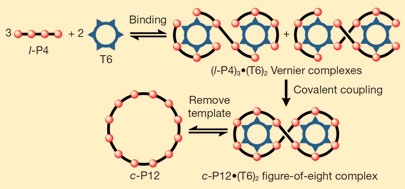
UK researchers have designed a new highly effective method to construct large molecules of a defined size using simple templates.Recent approaches to the construction of nanomaterials have made use of advanced methods such as living polymerisation and self-assembly, but these techniques often produce a mixture of products. Taking inspiration from nature, which uses sophisticated templates such as the ribosome to make precise complex molecules, Harry Anderson's group at the University of Oxford has developed a new strategy to synthesise macromolecules with precise lengths using basic templates...read more.
Related Posts Plugin for WordPress, Blogger...